Lightning Nodes
Using this guide, you'll be able to create a new account, select a subscription plan with credits, deploy your first Lightning or Bitcoin resource, securely back up your seed phrase, set a node password, and have your node fully running — typically in under 2 minutes.
Estimated reading time: 6 minutes
Deploy and manage Lightning Network (LND) and Taproot Assets (LITD) nodes on Comet Platform. This guide covers account creation, node deployment, and initial setup.
What is Comet Platform?
Platform-as-a-Service for Lightning Network Daemon (LND) and Lightning Infrastructure Toolkit Daemon (LITD) with Taproot Assets Protocol Daemon (TAPD).
Key Benefits:
Simple Infrastructure - No DevOps expertise or hardware management required
Non-Custodial - You control private keys; client-side encryption protects sensitive data
Transparent Pricing - Credit-based model with predictable costs
Fast Deployment - Production-ready nodes in under 5 minutes
Key Concepts
Node Types
LND Nodes
Lightning Network operations for instant, low-cost Bitcoin payments. Node tier (Standard, Pro, Enterprise) determined by subscription plan.
LITD (TAPD) Nodes
Lightning Network + Taproot Assets Protocol. Mint, transfer, and manage Taproot Assets on Bitcoin while maintaining Lightning capabilities.
Coming Soon: Bitcoin Core nodes planned for future release.
Credits
Credit-based pricing model instead of hourly billing:
Fixed monthly credit allocation per subscription tier
Credits continuously occupied by deployed resources (not consumed hourly)
Deleting nodes frees credits for other resources
Think capacity limit, not currency spent
Example: Basic plan includes 1,000 credits/month. Running nodes occupy credits; delete a node to free those credits.
Creating Your Account
Step 1: Sign Up
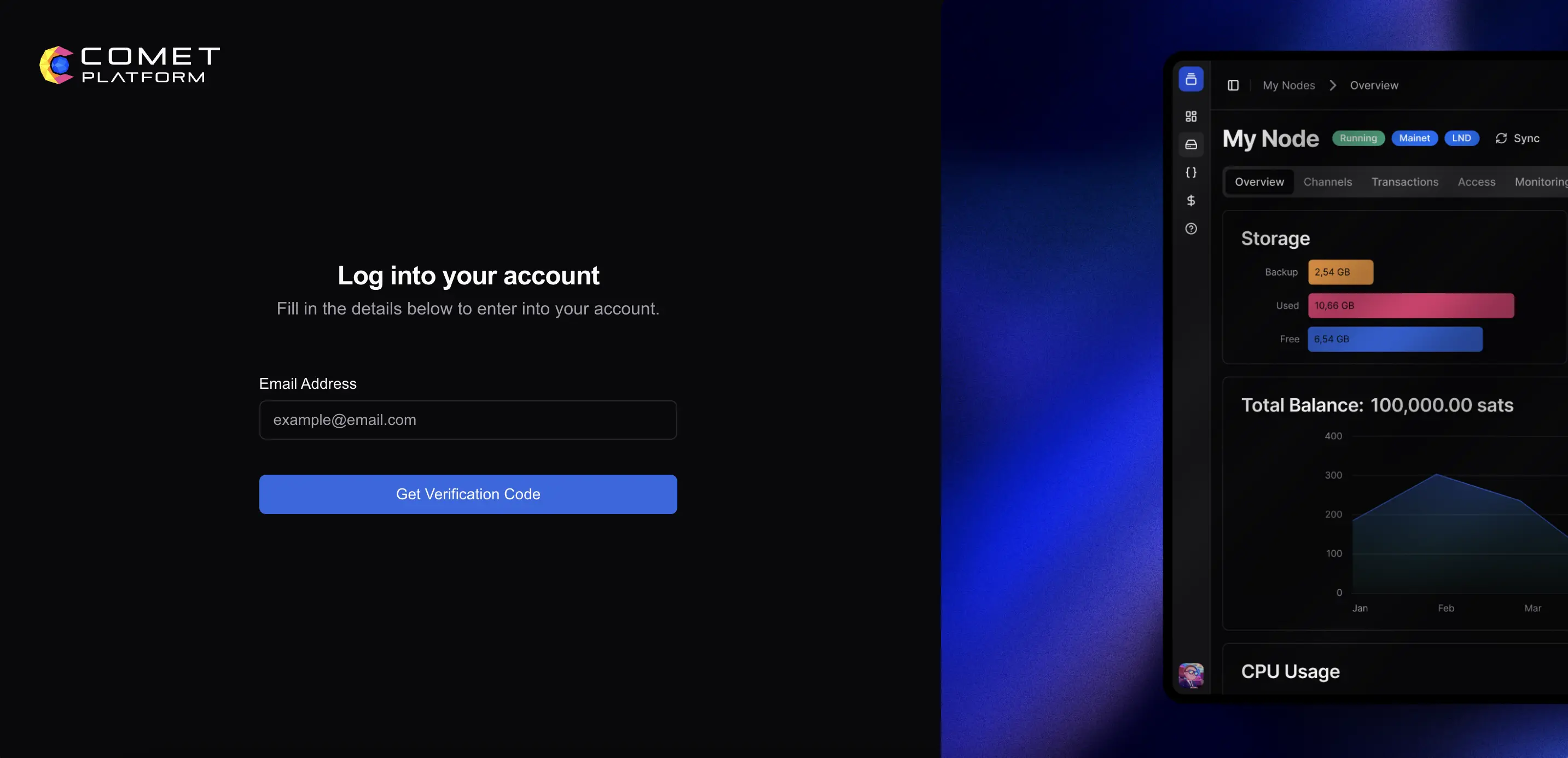
Navigate to dashboard.cometplatform.com
Enter email and click "Request OTP"
Enter 6-digit verification code from email
Click "Validate"
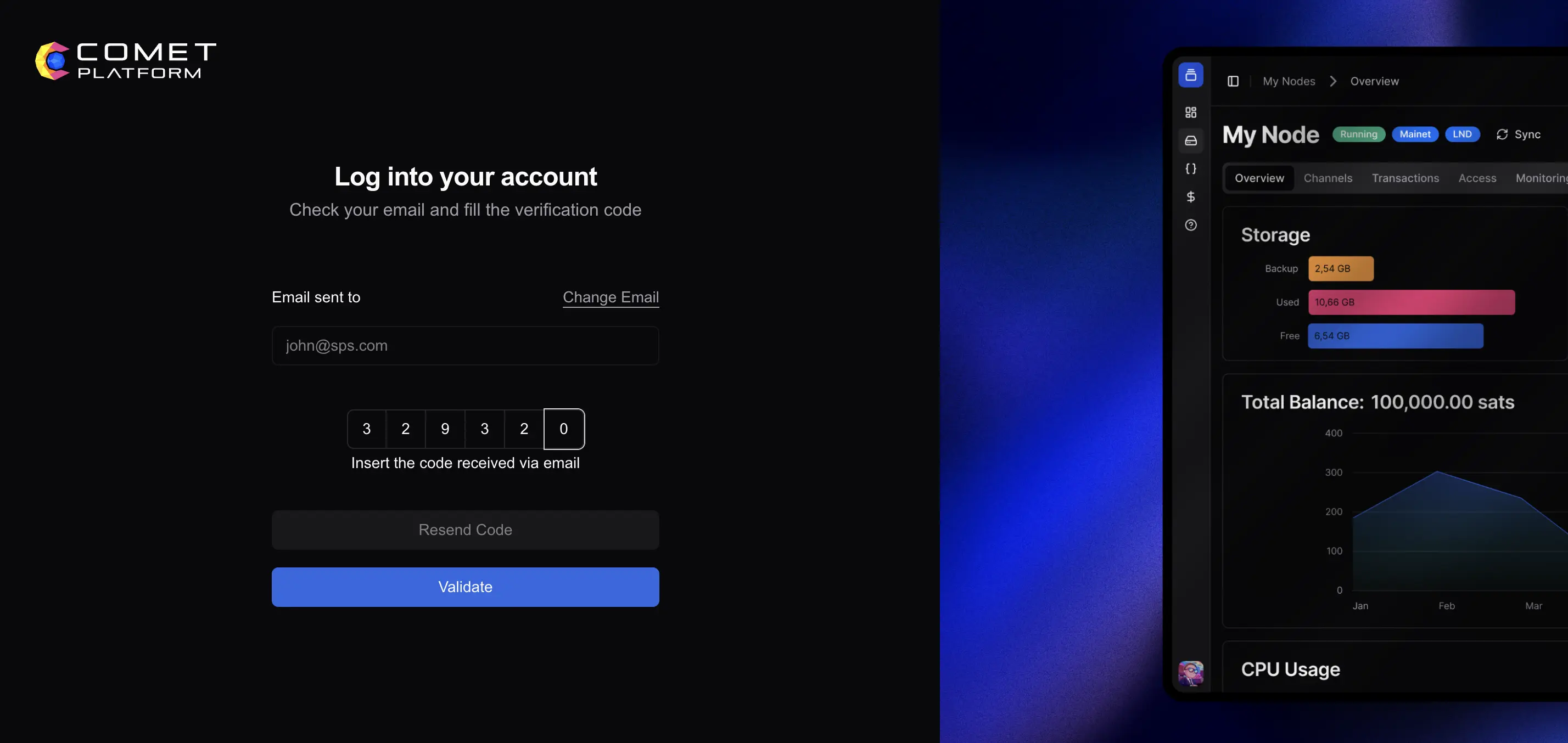
Passwordless authentication with One-Time Passwords (OTP) for security.
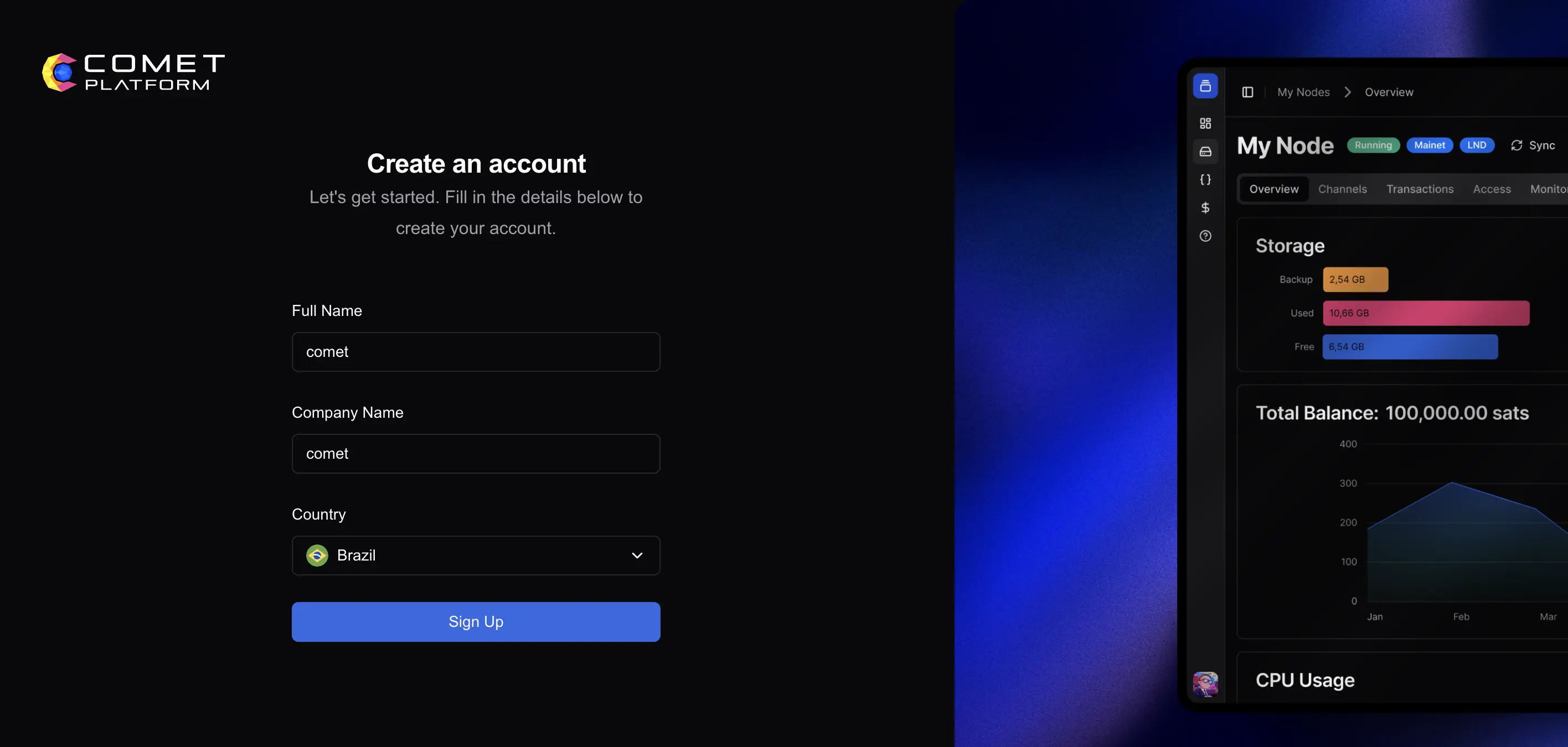
After successful authentication, new users will complete account creation:
Enter your full name
Provide your company name
Select your country from the dropdown menu
Click "Sign Up" to proceed
⚠️ Security: Maintain reliable email access. Enable 2FA on your email provider.
Step 2: Access the Dashboard
After completing signup and company details:
You are taken directly to the Dashboard
No subscription plan selection or payment method is required before this first redirect
You can immediately explore navigation, view available actions, and familiarize yourself with the interface
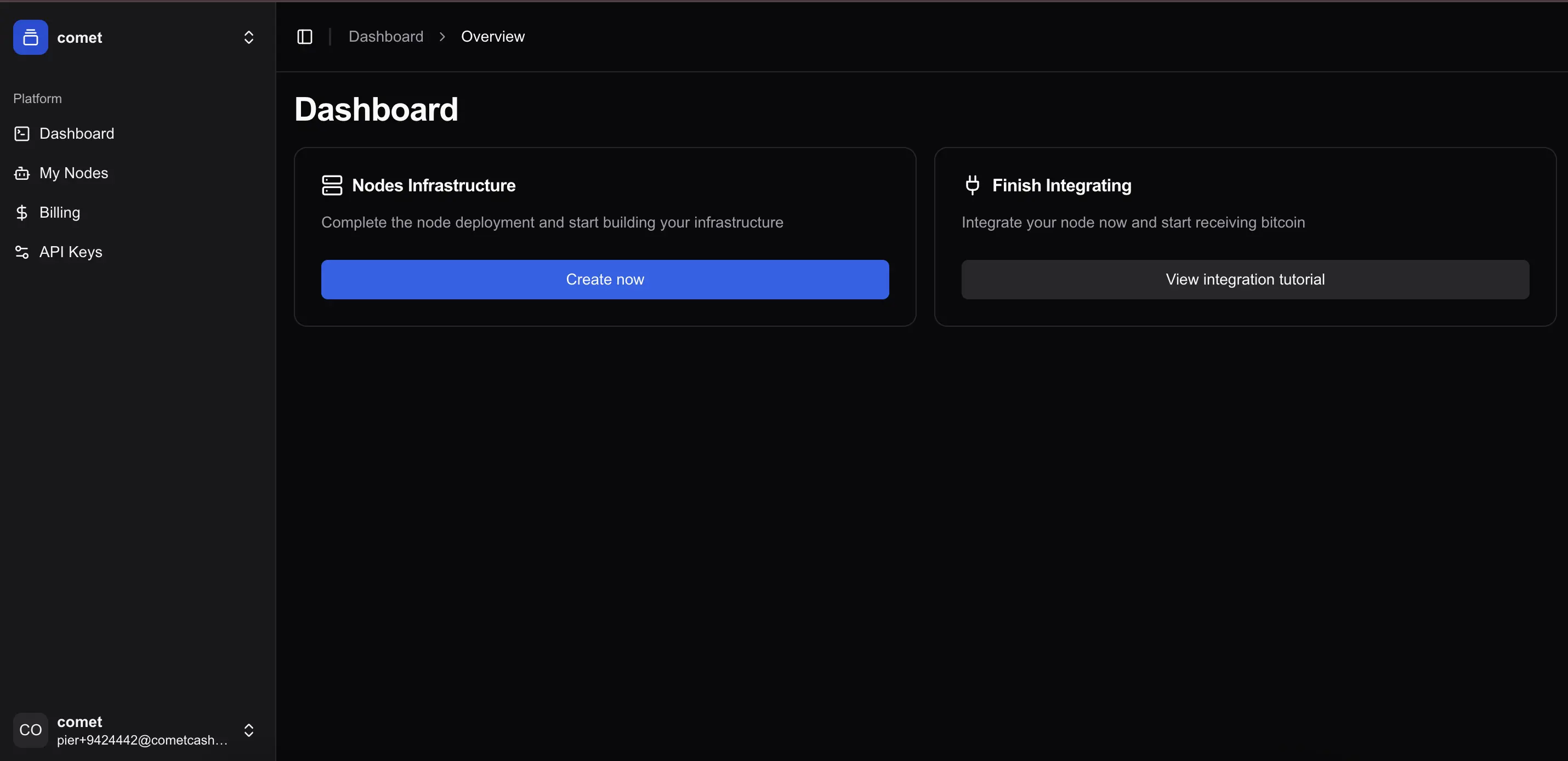
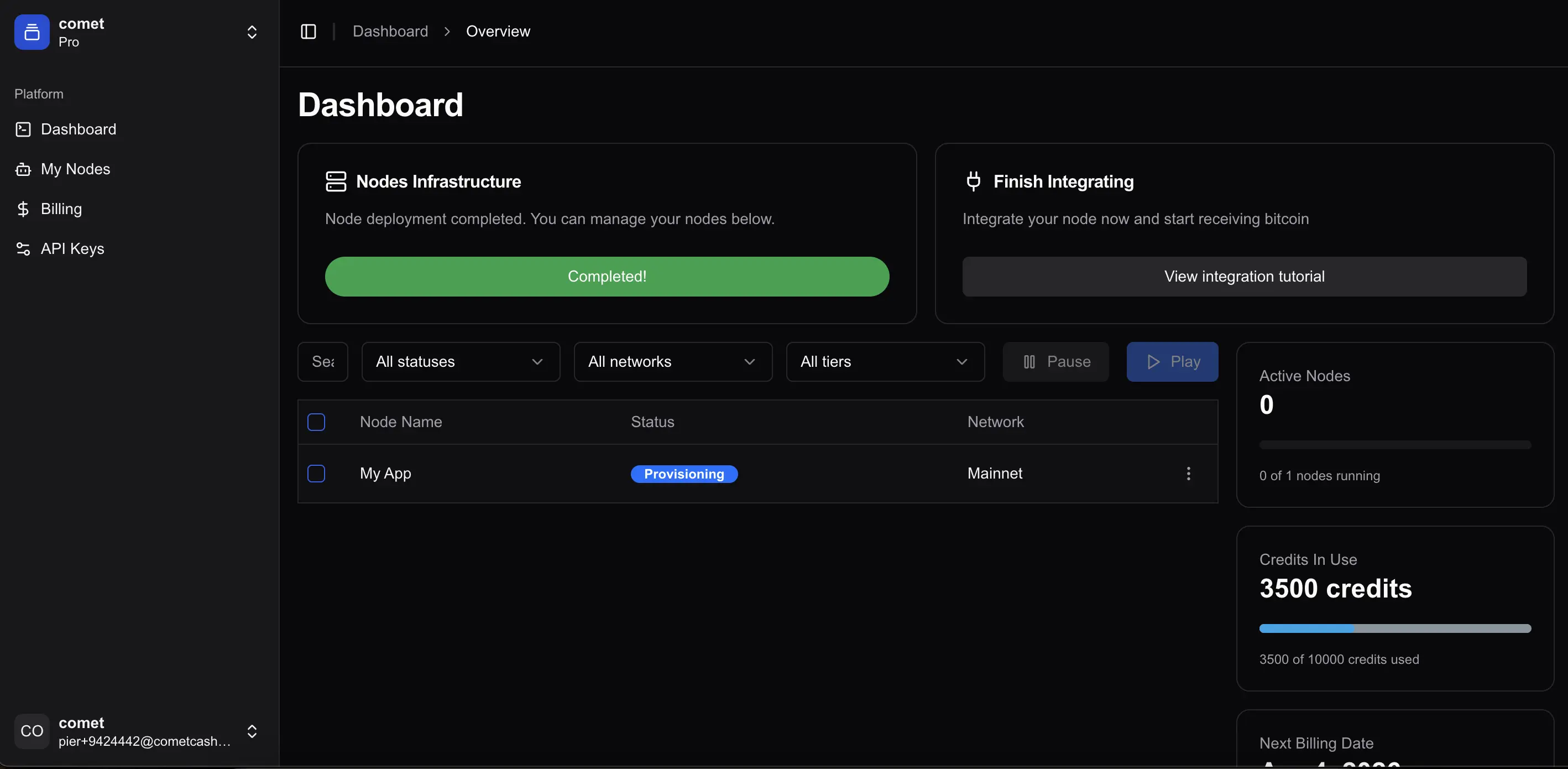
On the dashboard you will also see a guided Nodes Infrastructure card (for example, a "Create now" call-to-action) that represents the continuation of your first-time setup.
From here you can:
View the Dashboard overview
Navigate to My Nodes, Billing, and API Keys
Start the guided setup to create your first node
📘 Note: While you can browse the dashboard without a plan, you must activate a subscription (choose a plan and add a payment method from Billing or the guided flow) before you can actually deploy a node.
Next Steps After Signup
Once you are comfortable with the dashboard layout, you should:
Activate your subscription from the Billing section or from the guided setup:
Deploy your first node from the Dashboard (via the Nodes Infrastructure card) or from the My Nodes page, then follow the "Creating Your First Node" section later in this guide
Manage API access from the API Keys section after your node is up
Browsing the dashboard is possible without a plan, but deploying nodes and consuming credits requires an active subscription and payment method.
Dashboard Overview
Left Sidebar Navigation:
Dashboard - Node overview and credit usage
My Nodes - View and manage deployed nodes
Billing - Invoices, plan details, subscription management
API Keys - Create and manage programmatic access
User Profile Menu (bottom left):
Upgrade subscription, account settings, billing, notifications, logout
Main Dashboard:
Search bar for finding nodes by name
Filters: status, network (Mainnet/Testnet), tier
Bulk operations: Pause/Play buttons
Node list with Name, Type, Status, Network, Tier
Right Sidebar:
Active node count
Credits in use (with progress bar)
Next billing date
API Key Management
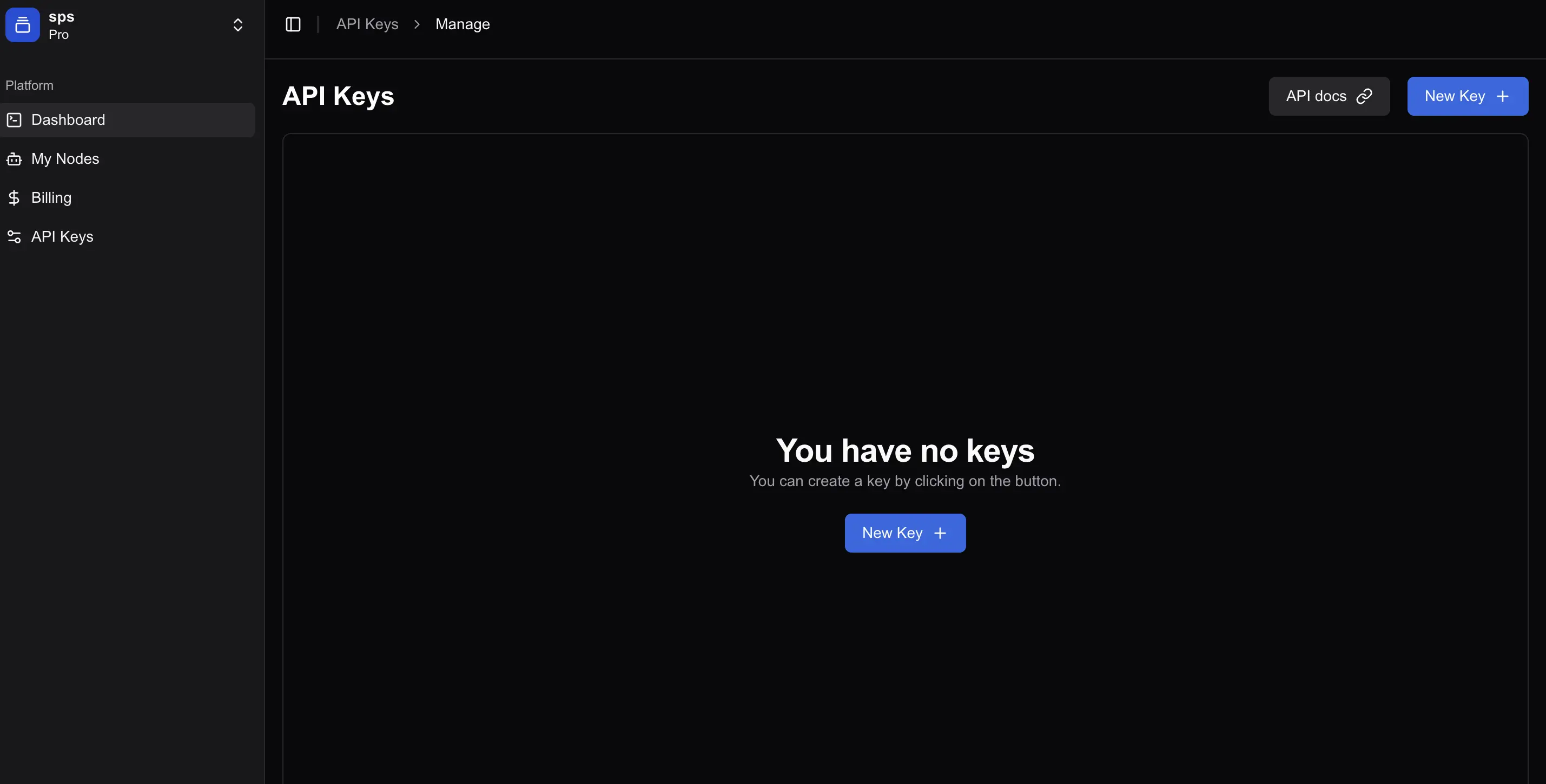
Create and manage API keys for programmatic access to your nodes:
Navigate to the API Keys section
View existing API keys and their status
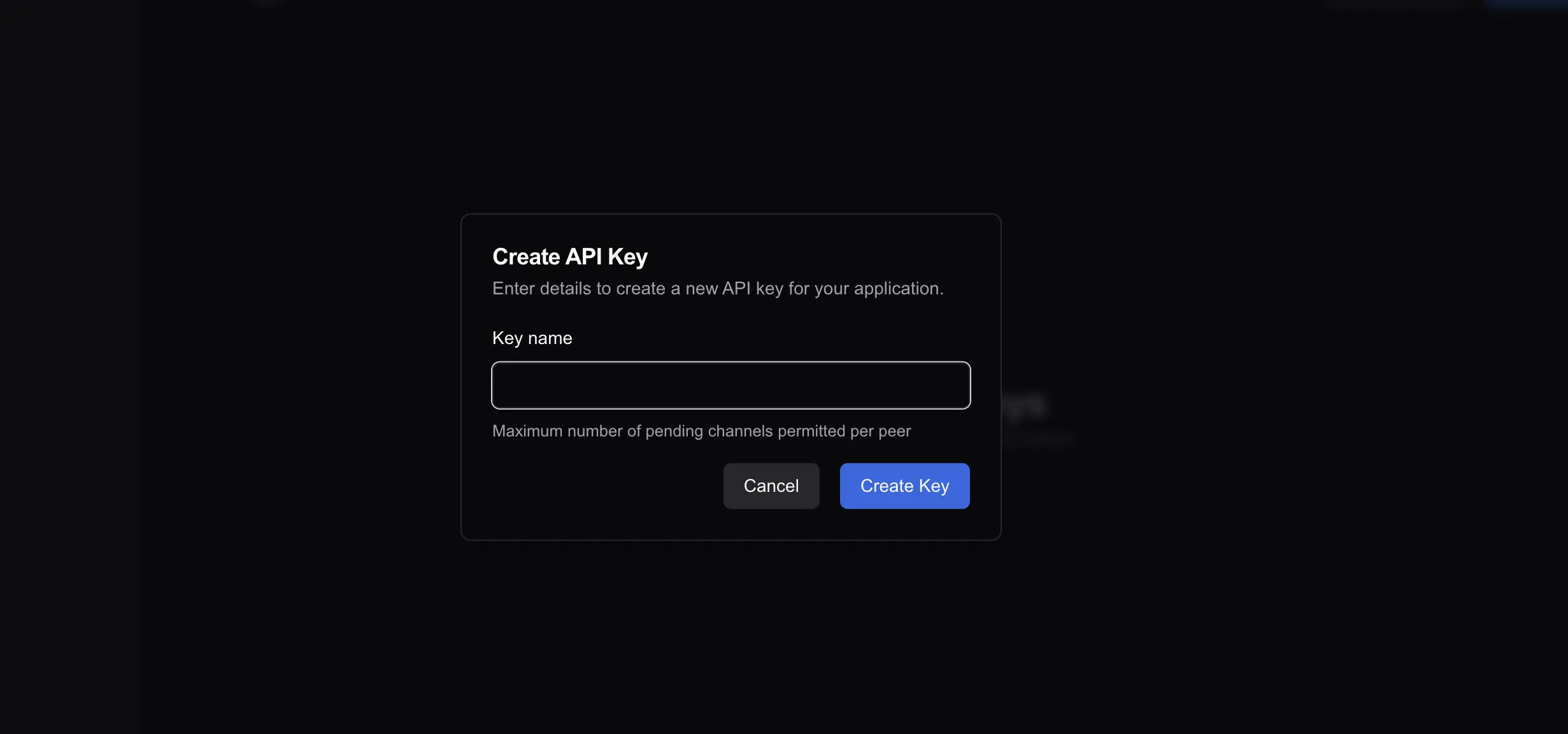
Click "Create API Key" to generate a new key
Give your API key a descriptive name (e.g., "MyFirstCLIKey", "DevSDKKey")
Copy and securely store the API key immediately (it will only be shown once)
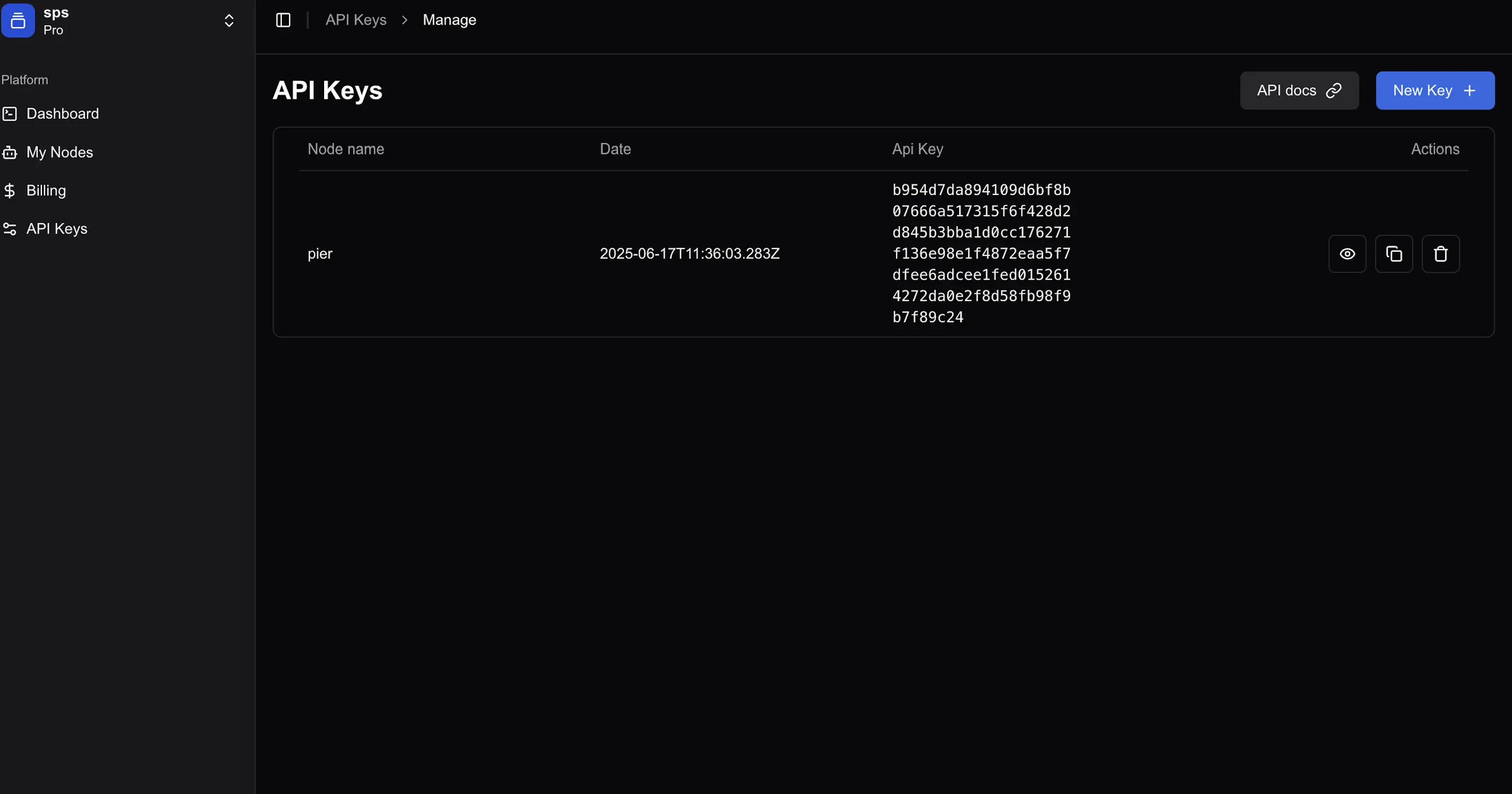
⚠️ Security: Treat your API keys like passwords. Do not share them publicly or commit them to version control.
Billing Management
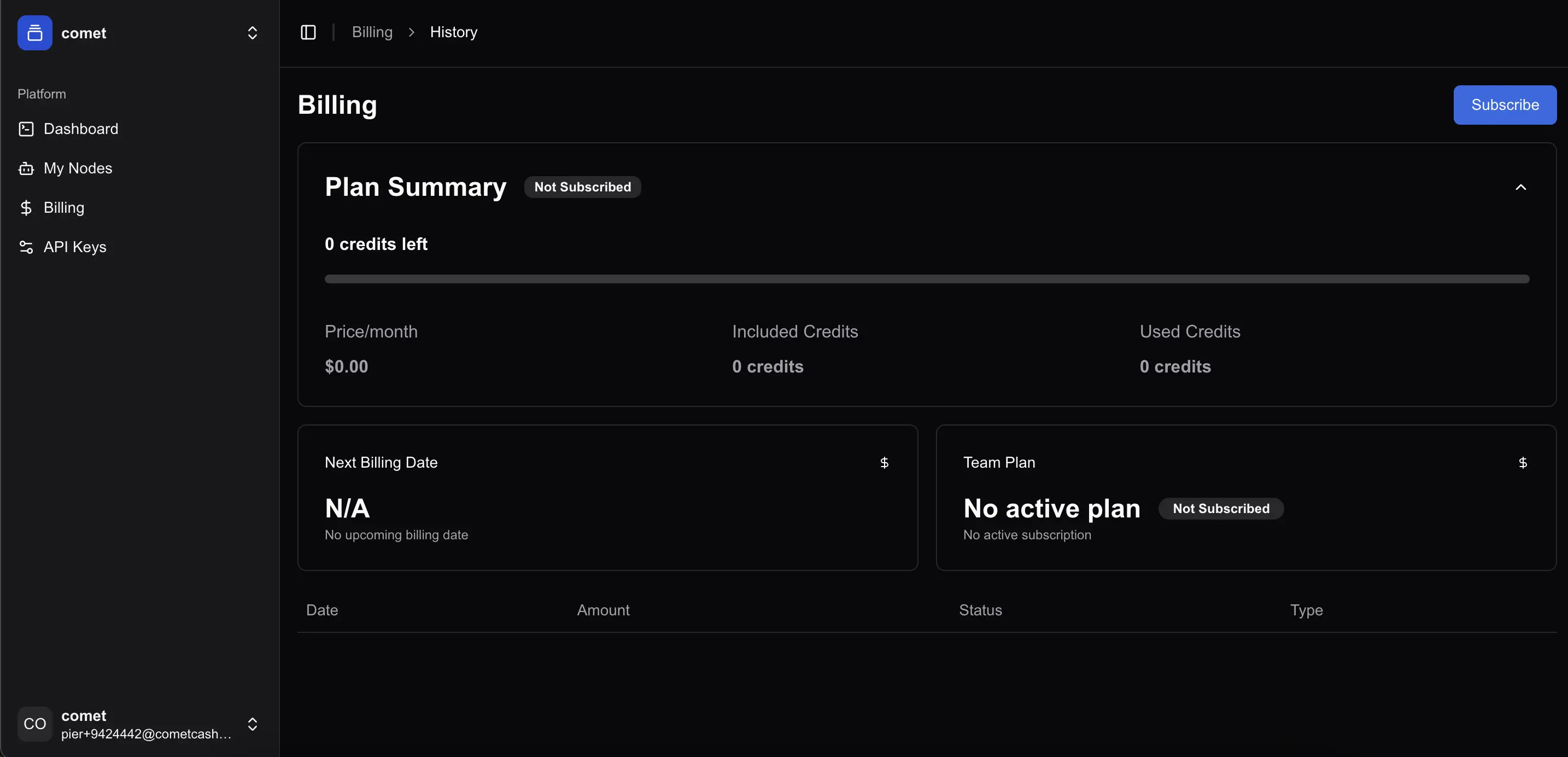
Use the Billing section to activate and manage your subscription:
Navigate to Billing from the left sidebar
Review the Plan Summary card (shows included and used credits, next billing date, and current plan status)
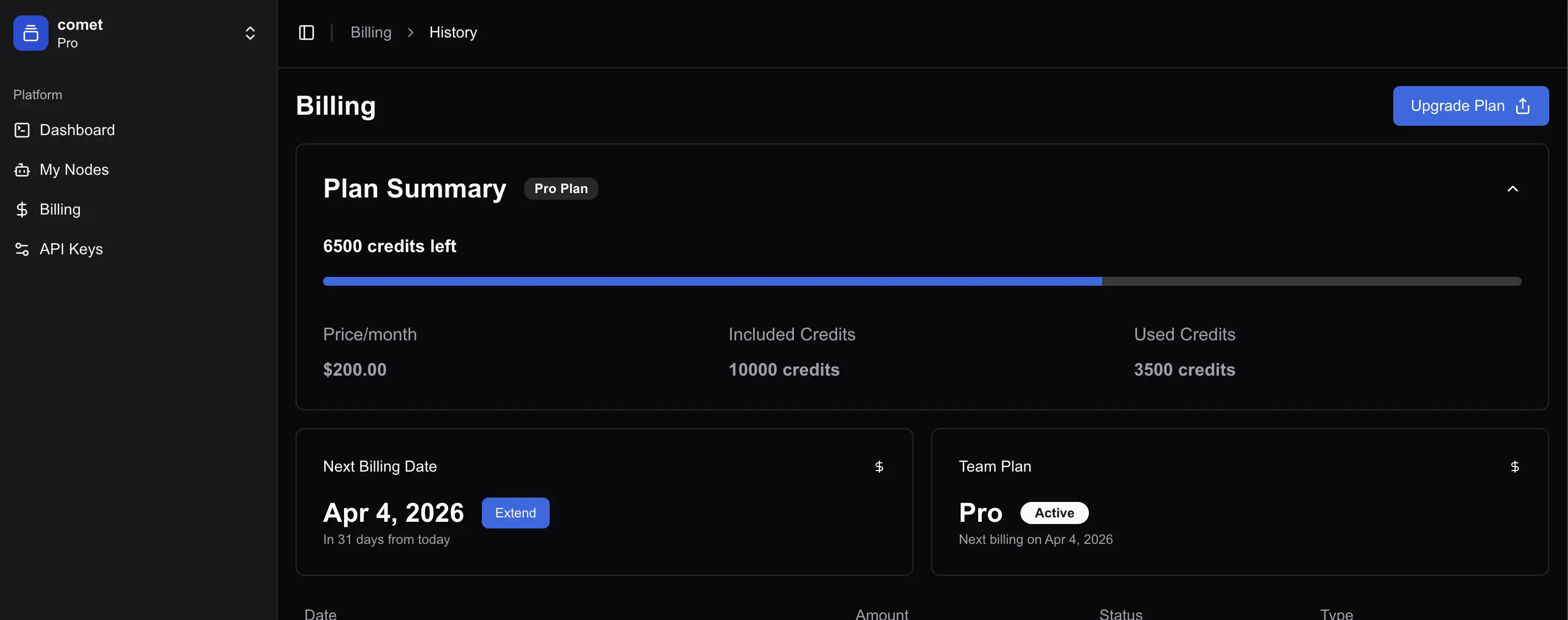
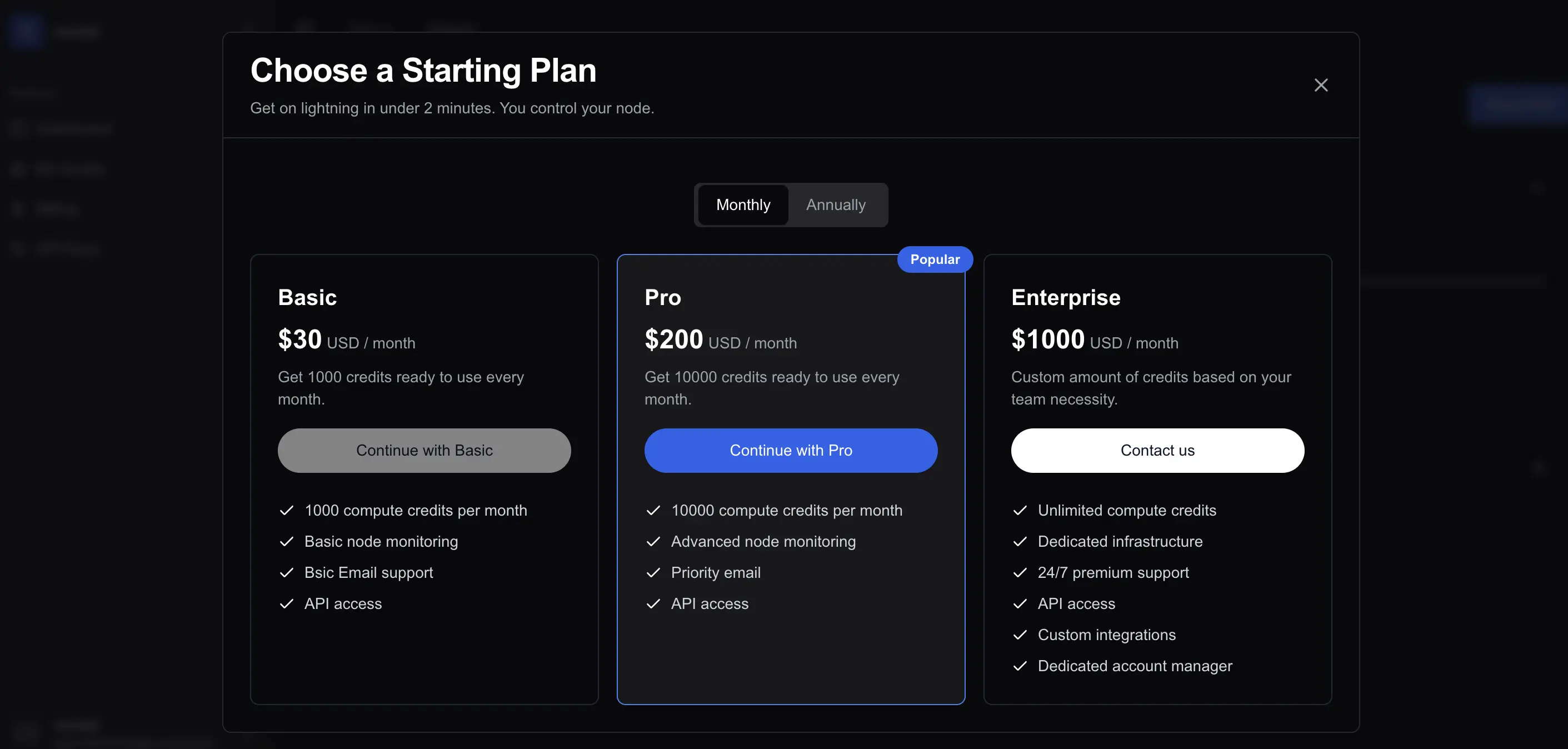
If you have no plan yet, click "Subscribe" (or "Choose a plan") to open the Choose a Starting Plan modal:
Select Monthly or Annually, then click "Continue with \"
In the Payment Method step:
After payment succeeds:
The Plan Summary updates to show your active plan (e.g., Pro – Active) and included/used credits
You can now deploy nodes from the dashboard or My Nodes using the available credits
You can later Upgrade Plan or manage payment methods from the same Billing page
Node Management
Return to your nodes to:
Monitor node status and health
Access detailed node information
Perform node actions (pause, resume, delete)
View node metrics and performance data
Manage node configurations
Navigate to "My Nodes" from the left sidebar to view all deployed nodes and access individual node details.
Creating Your First Node
📘 Prerequisites: To create and deploy a node you need an active subscription with available credits and at least one payment method configured in Billing.
Step 1: Open the New Node Modal
You can start node creation from multiple entry points:
From the Dashboard: Click "Create now" on the Nodes Infrastructure card
From My Nodes: Click the "+ New Node" button
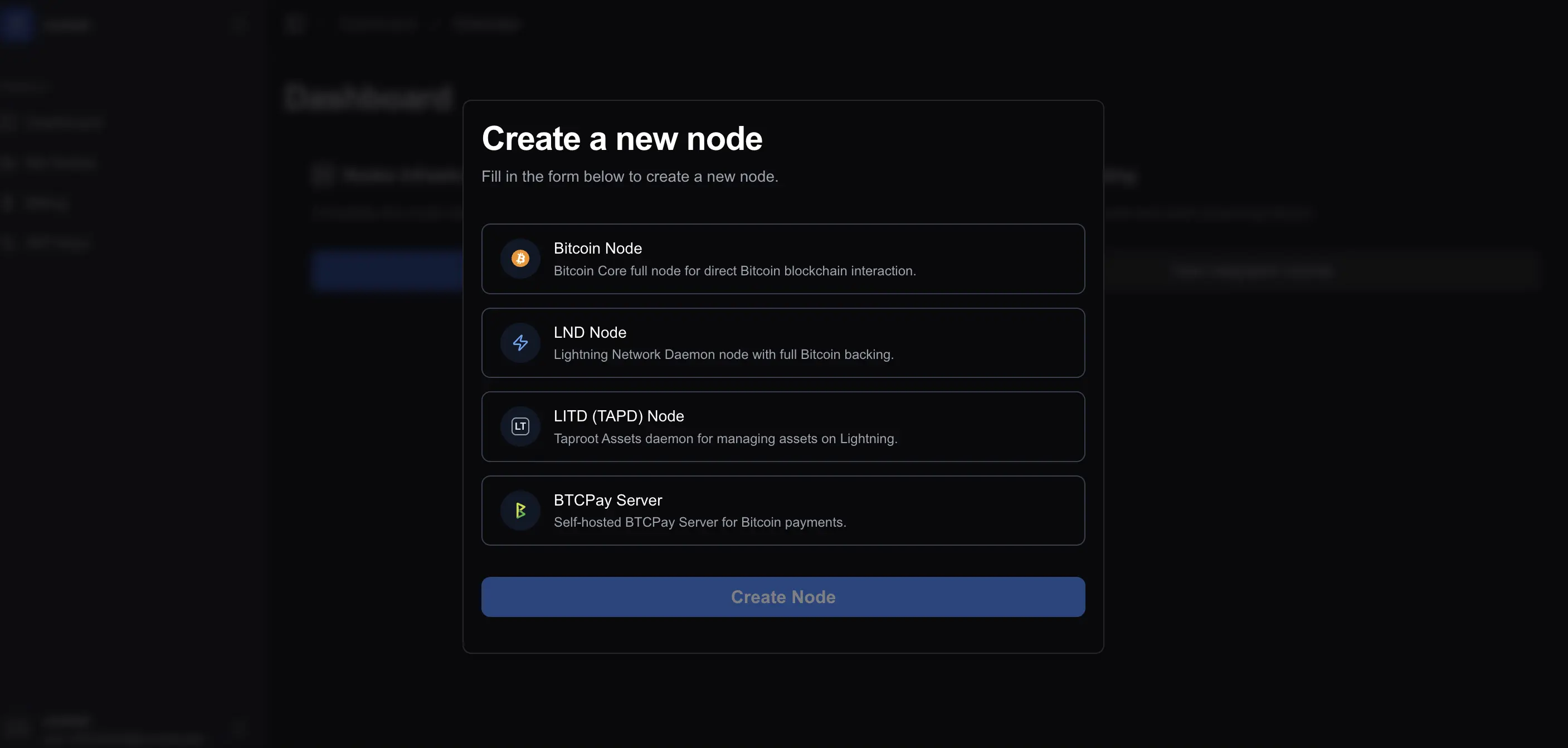
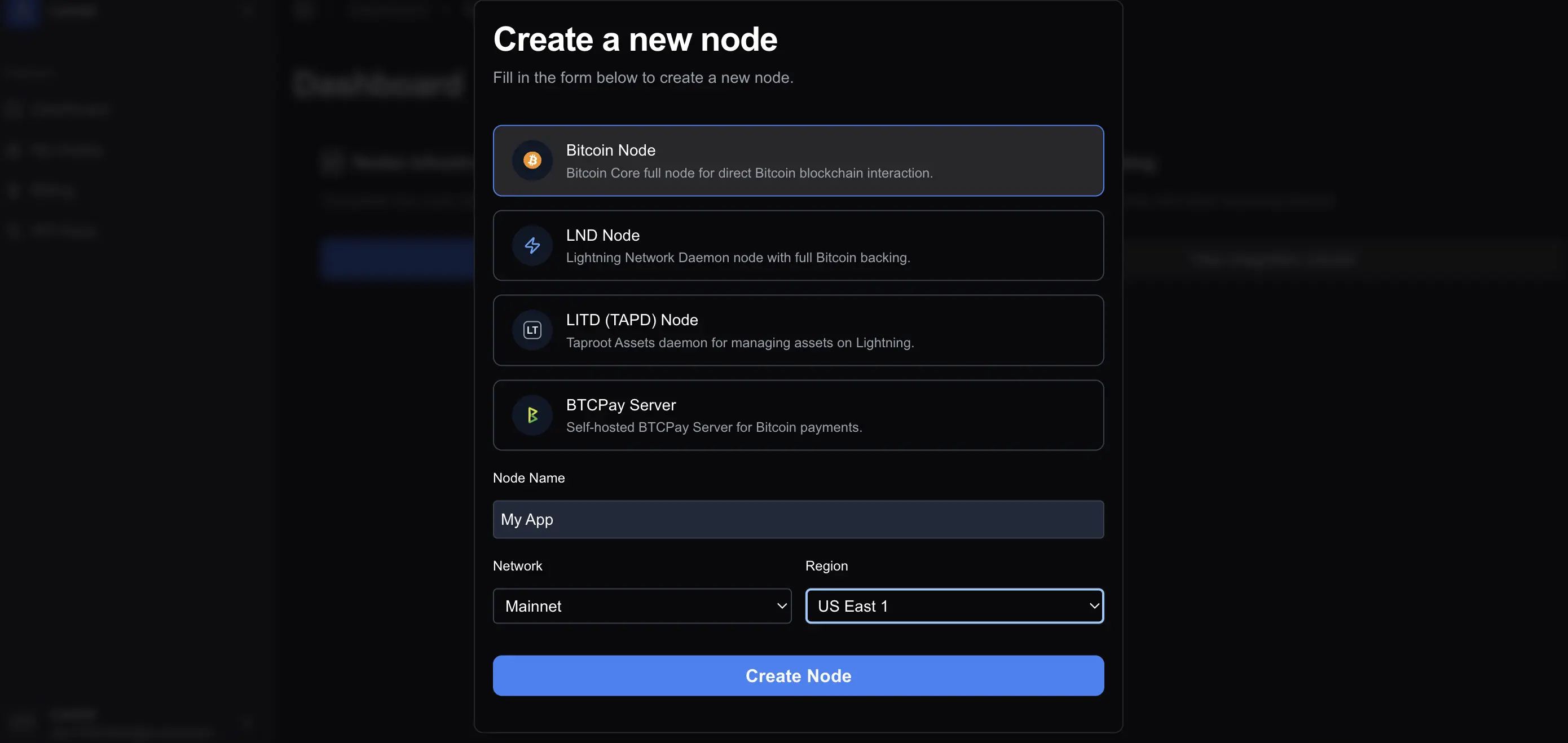
This opens the Create a new node modal.
Step 2: Configure Node in the Modal
In the Create a new node modal:
Select a node type:
Enter a Node Name (e.g., "My App")
Choose Network (Mainnet/Testnet)
Select Region (e.g., US East 1)
Click "Create Node"
If you have not yet activated a subscription, the flow will prompt you to choose a plan and add a payment method (as described in the Billing section) before creation can proceed.
Step 3: Node Deployment Progress
After confirming, you are redirected to the node’s deployment screen:
The header shows the node name (e.g., My App), type (e.g., Bitcoin Node), and network
A Deployment Progress section shows steps such as Allocating resources and subsequent initialization tasks
An Activity Log lists timestamped events (e.g., [05:14:04 PM] Allocating resources)
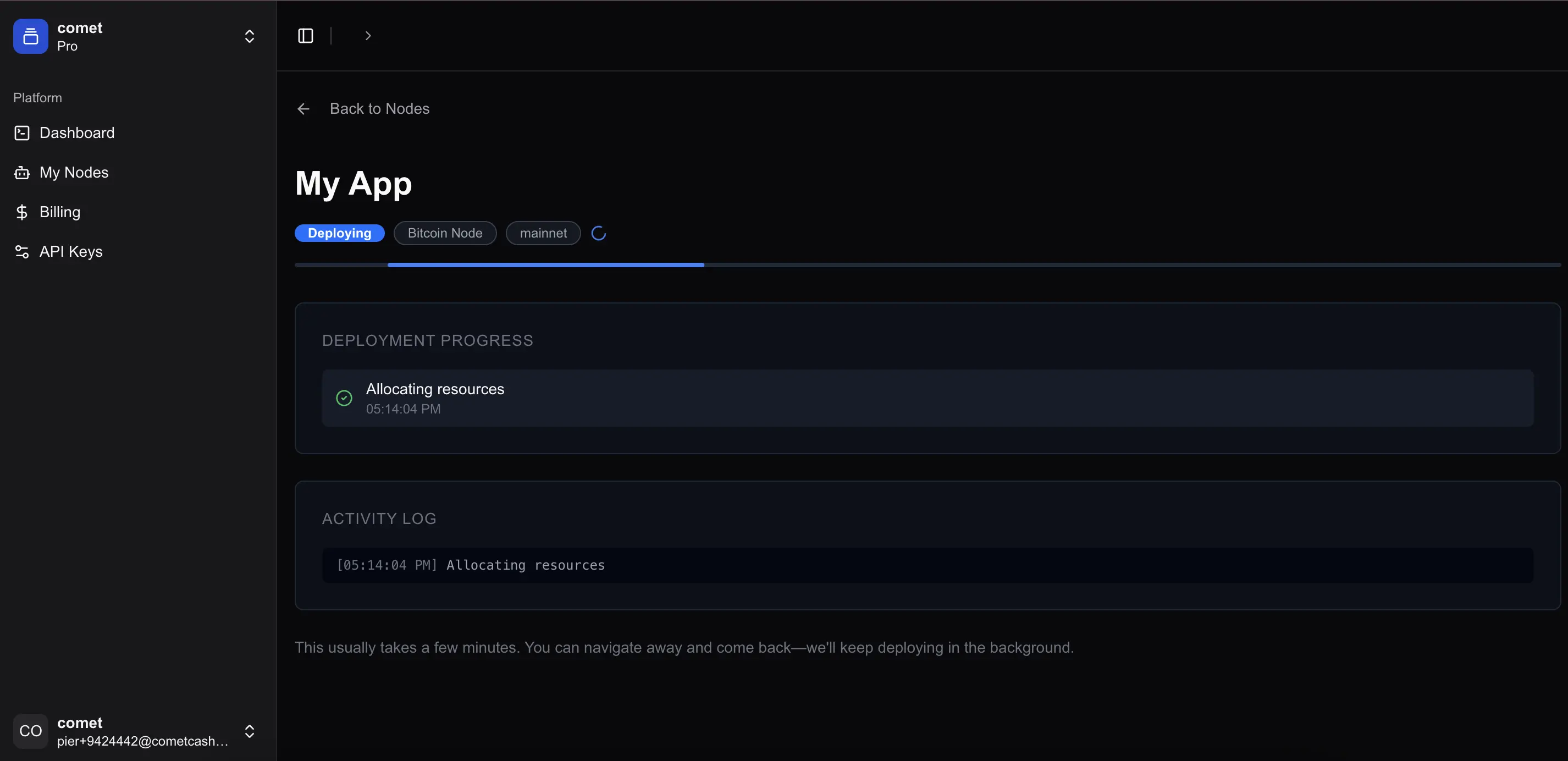
You can navigate away; deployment continues in the background.
Step 4: Deployment Complete and Dashboard View
Once deployment finishes:
The Nodes Infrastructure card on the Dashboard updates to "Completed!"
Your new node appears in the Dashboard table and My Nodes list with status (e.g., Provisioning, then Running) and network
Credits in use are updated in the Credits In Use section according to your plan
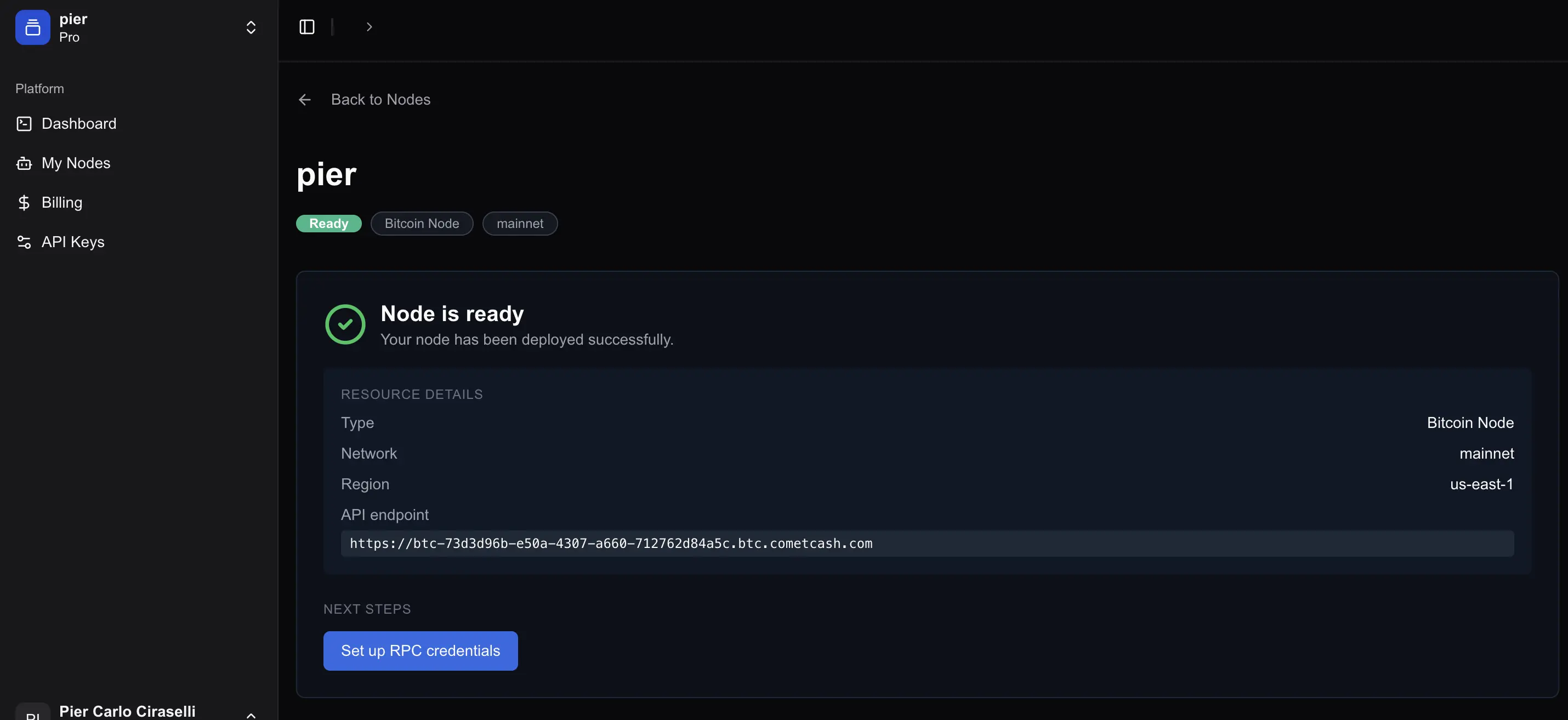
Step 5: Wallet, Seed Phrase, and Credentials Setup
For LND and LITD nodes, you must set up the wallet:
Seed Phrase – import an existing seed phrase or generate a new one.
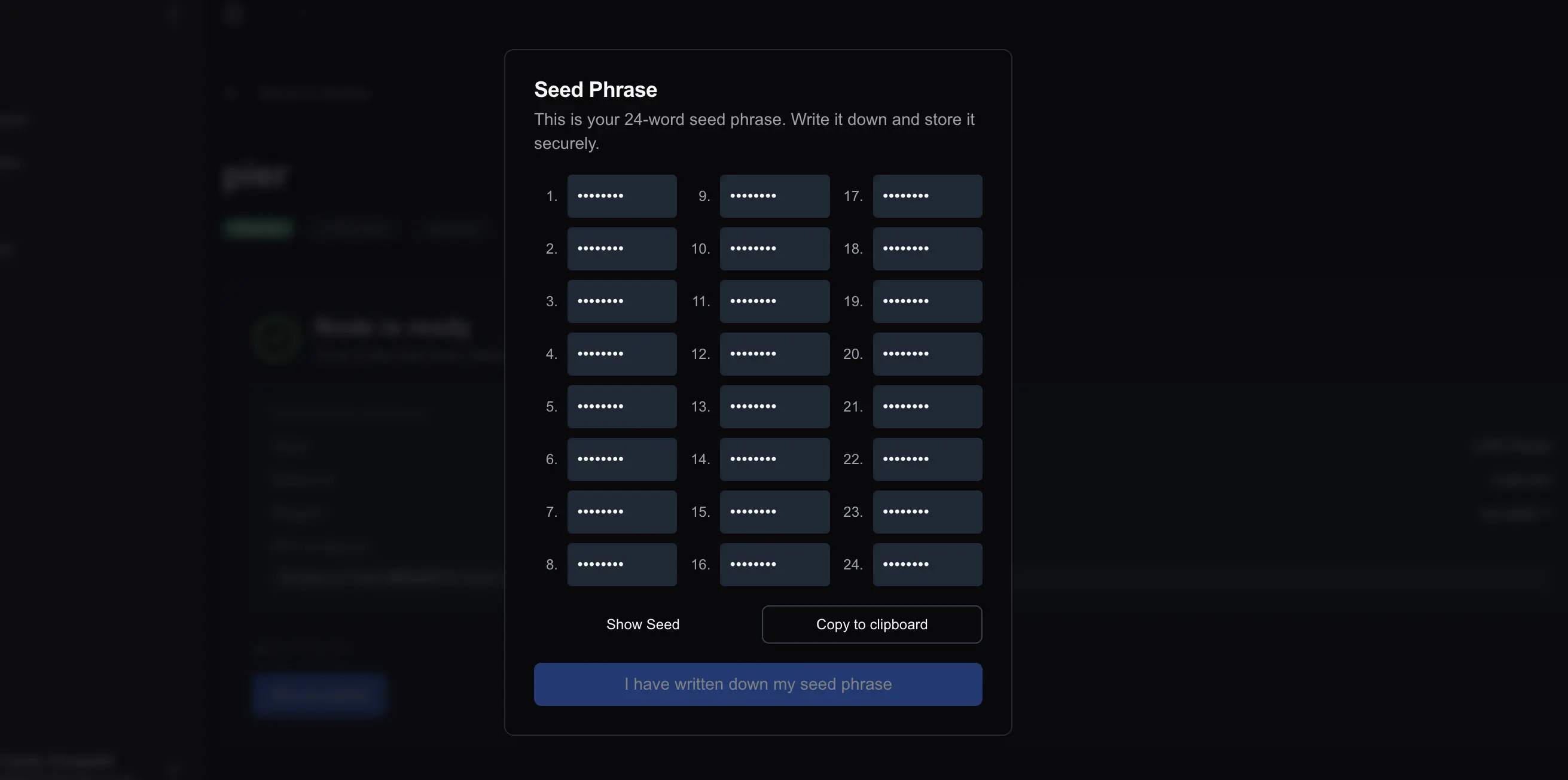
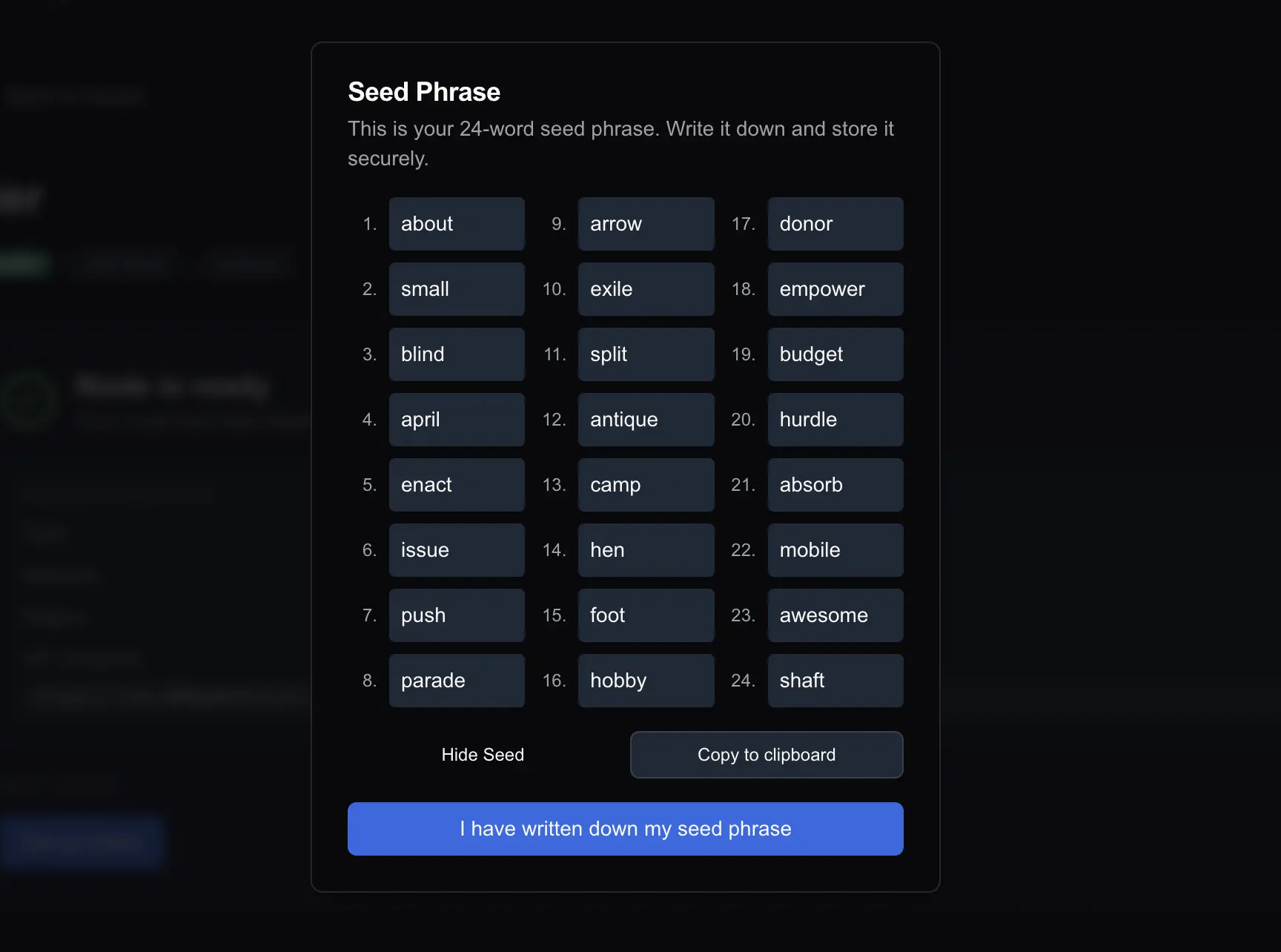
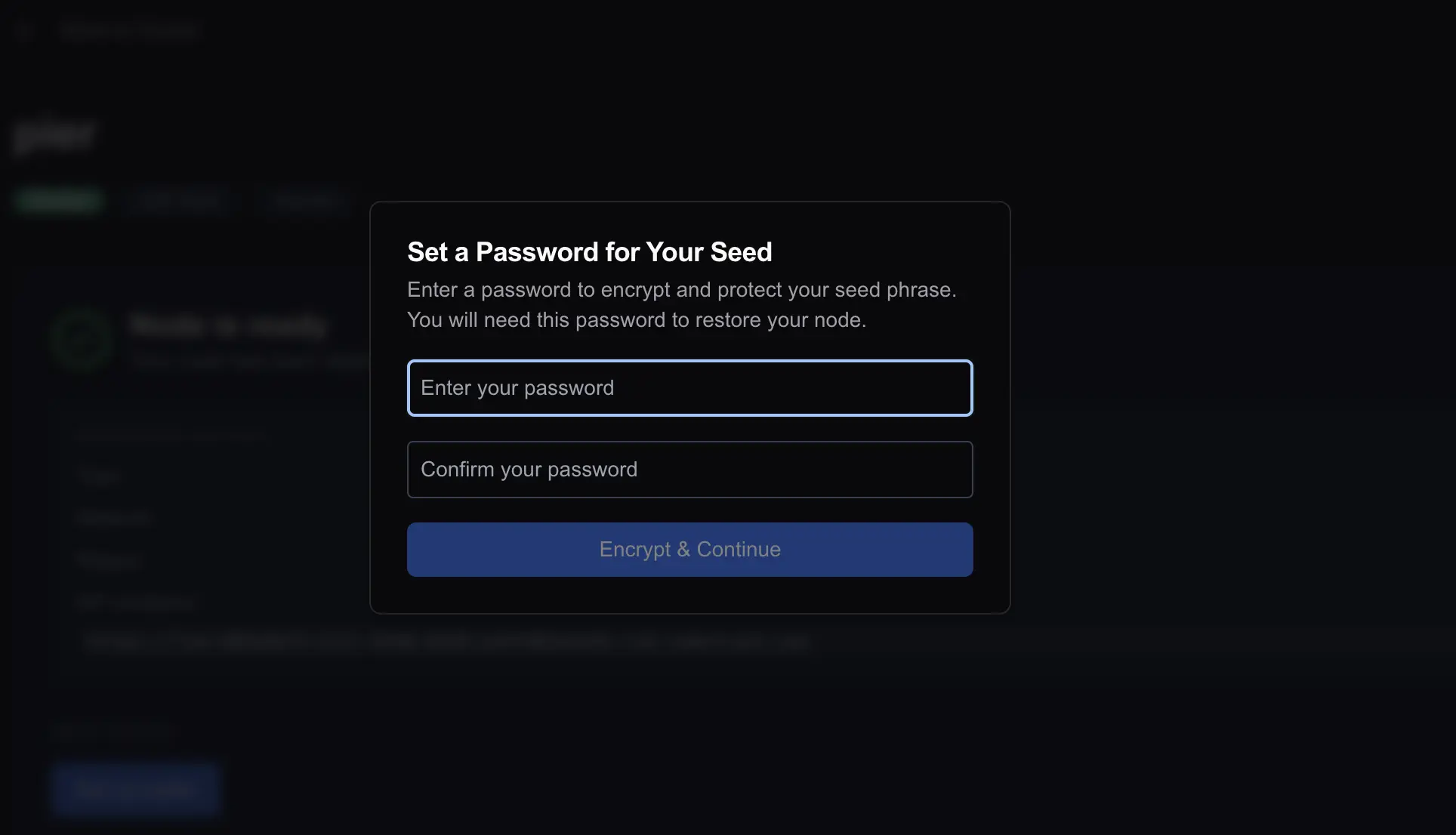
⚠️ Critical: Seed phrase is master key to wallet. Store securely offline. Never share or enter on untrusted sites.
For Bitcoin Nodes (bitcoind), you must retrieve and protect RPC credentials:
Obtain the automatically generated RPC username and password shown during node setup or in the node’s access details
Confirm these credentials are encrypted on Comet using your node password so they are never stored in plaintext
Save the RPC credentials in a secure location (for example, a password manager) along with your node password
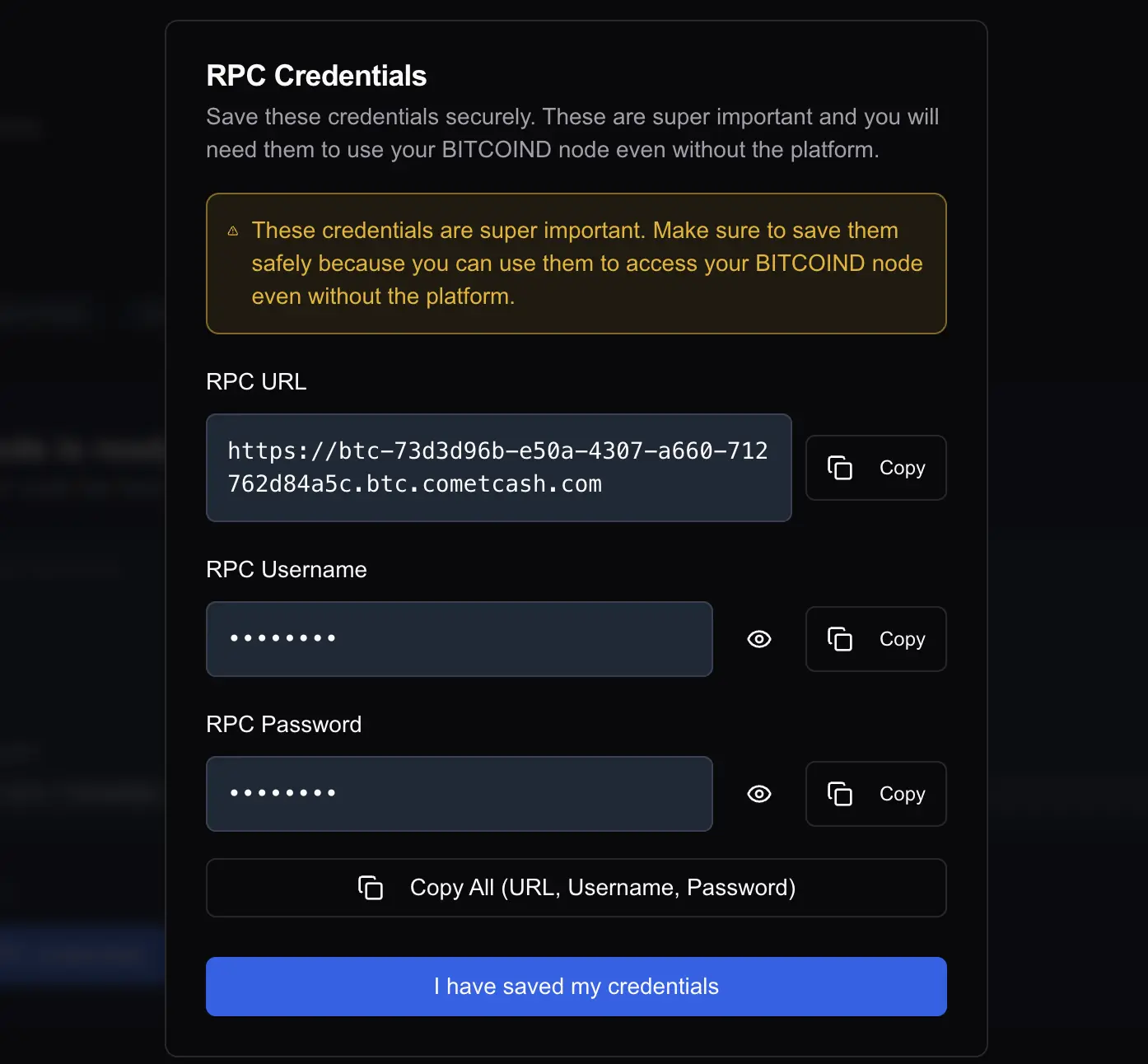
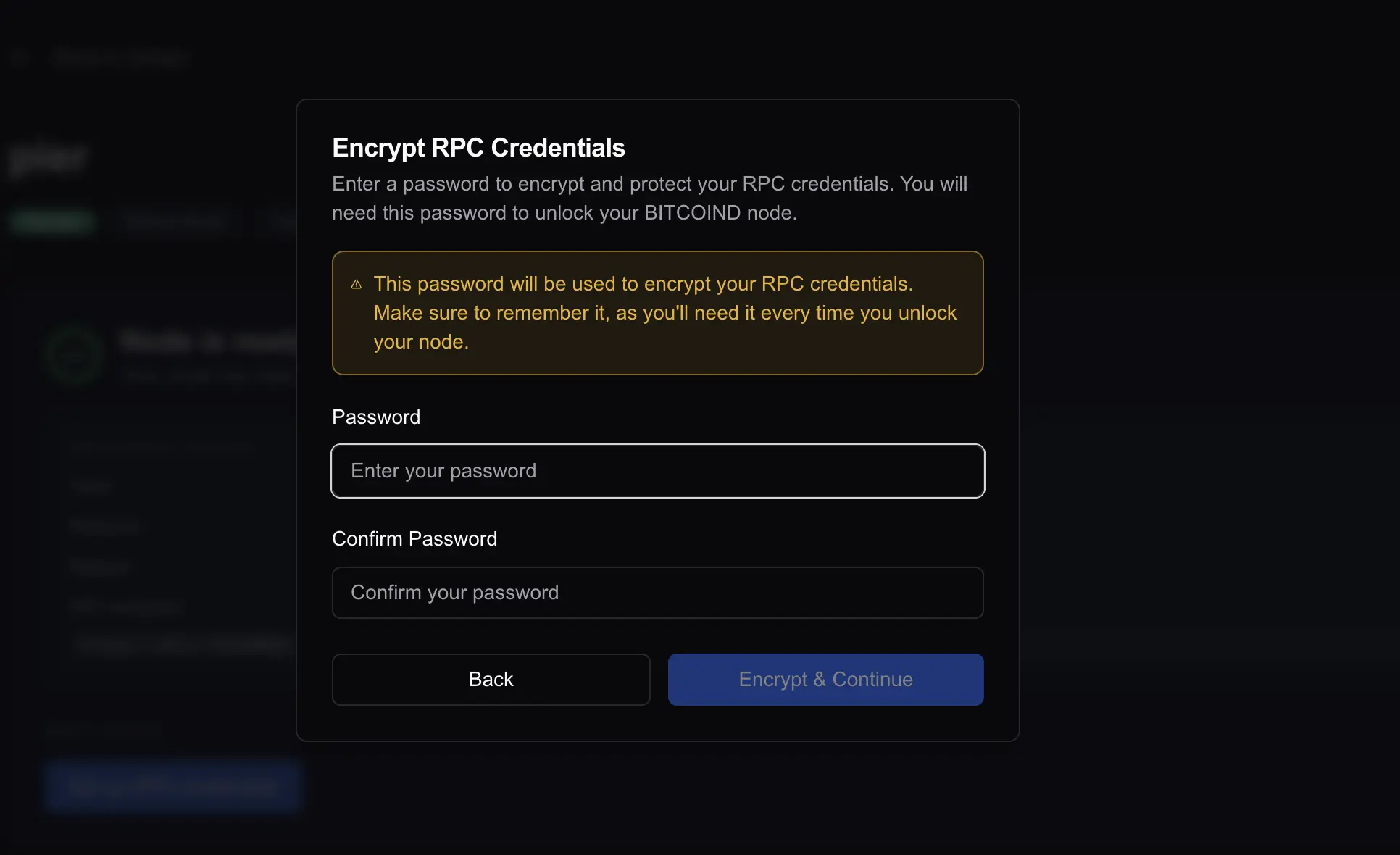
Seed Phrase Encryption:
View your generated seed phrase (it will only be shown once)
Securely store the seed phrase - click "Copy to clipboard" to save
Complete seed phrase encryption to secure your wallet and Init wallet
Step 6: Unlock Node
After completing the setup process, you'll be automatically redirected to the node details page for your newly created node.
Step 1: Node Details Page
You'll be automatically redirected to the newly created node page
Review the initial node status and configuration
Click the "Unlock Node" button to proceed
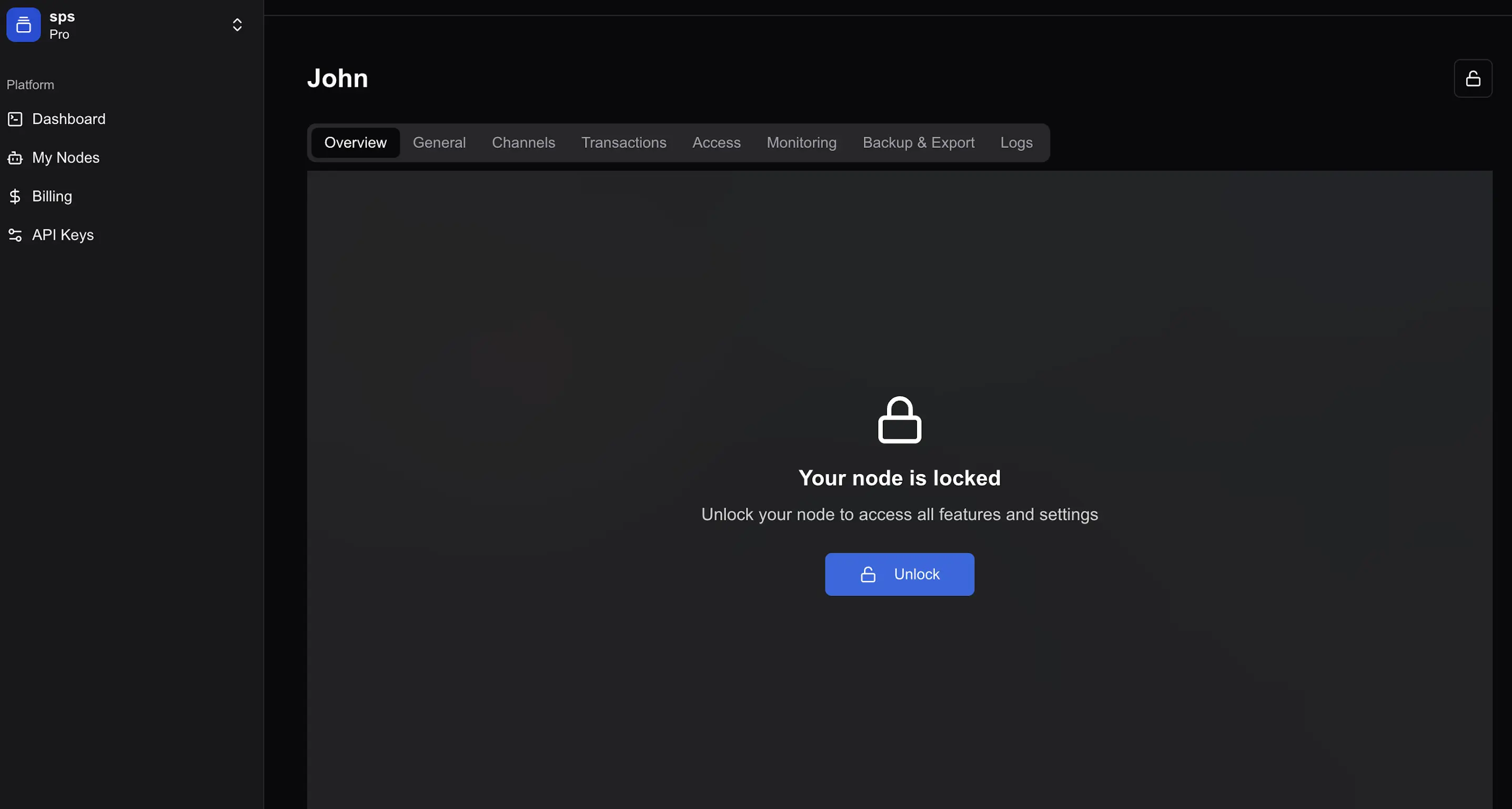
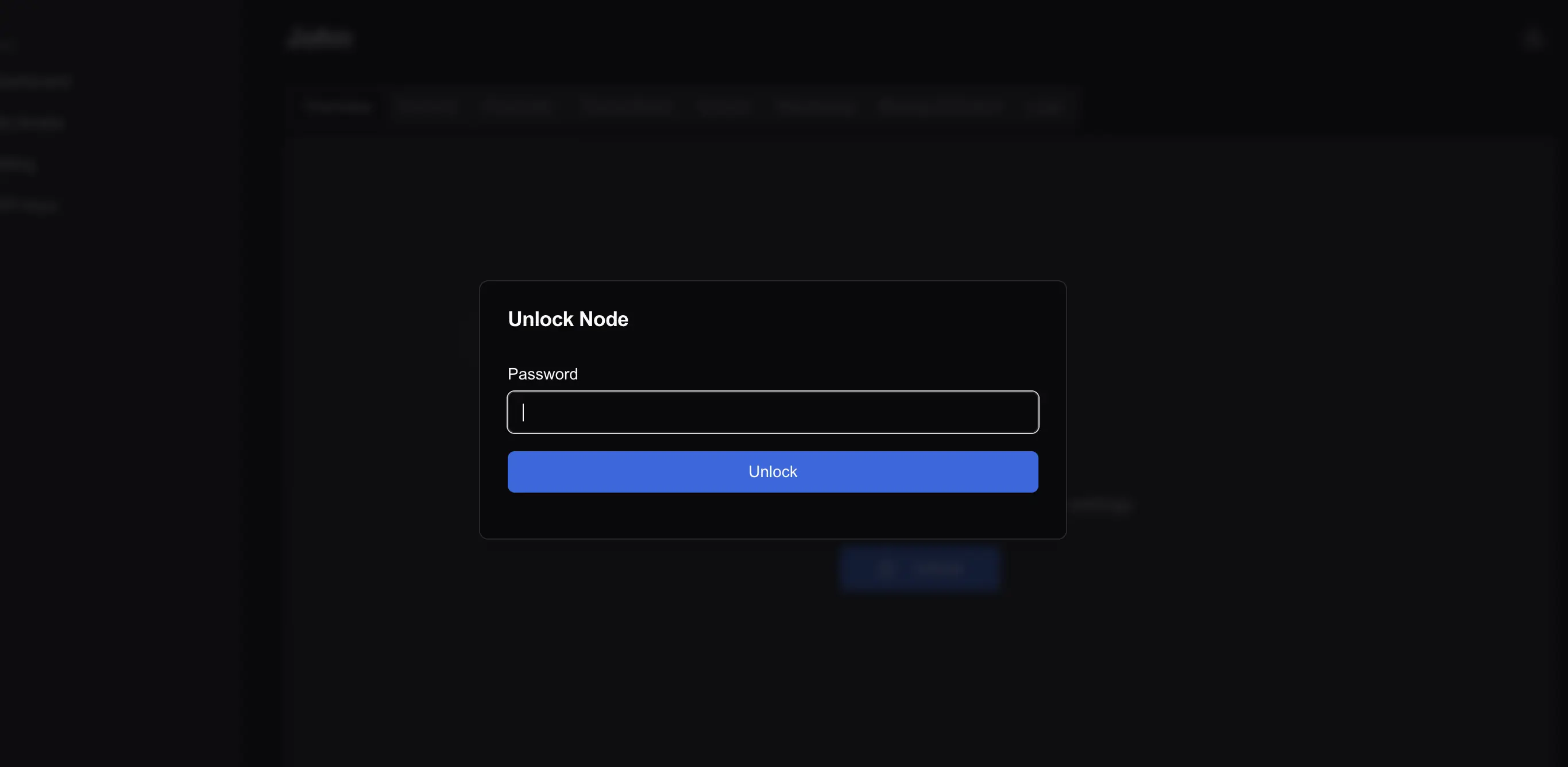
Step 2: Node Unlocking
Enter the password you set during node deployment
Click "Unlock" to proceed
Wait for the node to complete the unlocking process
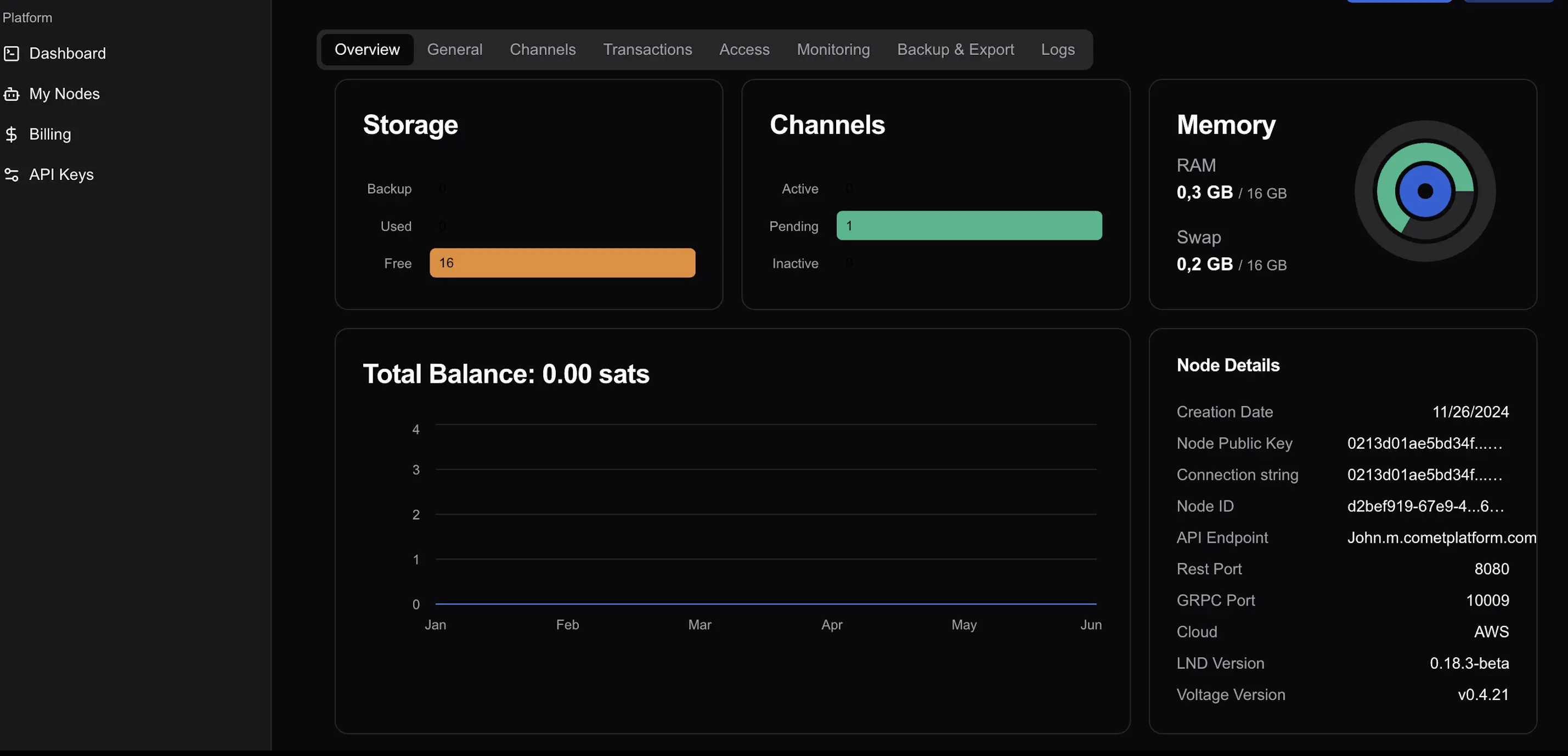
Step 3: Unlock Confirmation
View the successful unlock confirmation
The node will now be fully operational and begin syncing with the Bitcoin network
Step 7: Access Credentials
Node Interface Tabs:
Overview - Status, sync progress, metrics
Wallet - Manage Lightning wallet and on-chain funds
Channels - Open, manage, close Lightning channels
Access - Connection details and credentials
Backup - Download encrypted backups
Logs - View logs for debugging
General - Configure settings
Authentication: Node uses macaroons for authentication. Default admin.macaroon has full permissions. Create custom macaroons with "Bake Macaroon" feature in Access tab.
⚠️ Security: Store macaroons securely. They provide API access and should be treated like passwords.
Understanding Credits
How Credits Work
Credits occupied based on node type and tier. Dashboard right sidebar shows:
Total credits (e.g., 1,000 for Basic plan)
Credits in use
Progress bar visualization
📘 Note: Check Billing page for current consumption rates and detailed usage.
Credit Continuity
Credits are capacity, not usage:
Monthly subscription provides fixed credit capacity
Resources continuously occupy credits
New billing cycle: existing nodes continue occupying same credits
Fixed subscription fee each month
Freeing Credits
Delete unused nodes to make credits available:
Credits become immediately available after deletion
Deploy new resources with freed credits
No prorated refund (capacity-based pricing)
Low Credit Alerts
Alerts trigger when available credits drop below threshold (default: 10%). Options:
Delete unused nodes
Upgrade subscription
Optimize infrastructure
Next Steps
Build with Your Node
Connect via API
Use gRPC or REST endpoints. See API Reference.
Open Lightning Channel
Required to send/receive payments. See Node Management Guide.
Mint Taproot Asset (LITD nodes)
See Taproot Assets Guide.
Advanced Features
Node Management - Advanced operations, liquidity, optimization: Node Management Guide
Automated Backups - Access from Backup tab: Security & Backup Guide
Monitoring - Performance monitoring and alerts in Overview tab
Developer Resources
Get Help
Documentation: cometcash.com/documentation
API Docs: Access from API Keys page
Support: Use Company ID (Account Settings) when contacting support
FAQ
How long does node provisioning take?
Under 5 minutes for most nodes.
Can I change my subscription plan?
Yes. Upgrade or downgrade anytime from Billing page. Upgrades take effect immediately.
What happens if I run out of credits?
Cannot deploy new nodes. Existing nodes continue running. Delete unused nodes or upgrade subscription.
Is my data secure?
Yes. Non-custodial architecture. Node passwords and seed phrases never transmitted to or stored by Comet servers.
Can I migrate from self-hosted nodes?
Yes. Import existing seed phrase during node creation.
What if I forget my node password?
Use seed phrase to recover access to funds. Store both password and seed phrase securely.